

Prefer audio? Subscribe to the Come and See podcast on Spotify.
Called to welcome
Every time we share the Eucharist and come to Holy Communion we gather round the table and we meet our risen Lord in bread and wine. Jesus is the one who welcomes us in and spreads this table before us. Jesus is the Lamb of God who takes away the sin of the world. We come needing forgiveness and cleansing week by week. Jesus is the Bread of Life who brings new hope and energy and strength for the journey.
Each time we meet our risen Lord, there is a potential for all of us to be changed, to be transformed from within, through the power of God in Christ. Remember those words from the ancient prayer of humble access: that we may dwell in him and he in us.
As Christ dwells in us, together, so we are changed to be more like Jesus. Christ is forming his church, building his body, through every Eucharist.
All of us are called to welcome others as Christ welcomes us. That might mean finding practical ways to share in offering this service Sunday by Sunday. No parish church can function without a whole range of committed volunteers to steward and serve coffee; to sing or maintain the building; to lead the prayers, provide financially and care for God’s people. It might mean befriending those who are new in our community. It might mean opening our own homes and offering hospitality to others in church or community.
All of us are called to extend forgiveness to others just as we have been forgiven. Remember the fourth line of the Lord’s prayer: forgive us our sins as we forgive those who sin against us. Remember that saying of Jesus in the Sermon on the Mount about leaving your gift at the altar and setting things right with your brother or sister before you make your offering (Matthew 5.23).
All of us are called to build others up and nurture them in faith and in life just as Jesus the Bread of Life offers us his life each day. We are to be channels of God’s life and peace to others. Just imagine the difference we could make if every time Christians gathered around the table of the Lord we left determined to welcome others; to forgive others; to build others up by all we say and do. The grace and love which is there as we celebrate this meal Sunday by Sunday overflows into all the world.

Rich, deep wine
The same is true as we will see, of our next encounter with Jesus as the true vine. We’ve focussed so far on Jesus as the Bread. But there are two elements and two rich symbols in our meal of Holy Communion: there is bread but there is also rich, deep wine.
Bread and wine go together in the scriptures. In a very early story in the Book of Genesis, Abraham is caught up in a great battle between nine kings (Genesis 14). After the battle, Genesis tells us:
“And King Melchizedek of Salem brought out bread and wine; he was a priest of God most High”. Melchizedek offers Abraham a solemn blessing.
In Proverbs 9, Wisdom personified builds a house, prepares a feast and invites everyone to come and eat:
“Come, eat of my bread and drink of the wine I have mixed.”
Psalm 104 speaks of wine to bring joy and bread to give strength (104.15). Wine has a leading role in the great feast in Isaiah when God will destroy death for ever:
“On this mountain the Lord of hosts will make for all peoples a feast of well matured wines, of rich food filled with marrow, of well matured wines strained clear. And he will destroy on this mountain the shroud that is cast over all peoples. The sheet that is spread over all nations; he will swallow up death for ever”
Isaiah 25.6-7
So how do we understand and meet Jesus in the wine in the Eucharist? What does this symbol mean?
Wine is a symbol of two different things here and we find meaning in the tension between them. Bread is a symbol for strength and the power to live. Bread represents the ordinary days. But wine goes beyond the ordinary. Wine is a symbol of both suffering and of joy, finely woven together – a lesson in how we are to understand our lives.
Wine in the Eucharist represents the blood of Christ, the blood of the new covenant. We know this from the words of institution at the last supper:
“This cup that is poured out for you is the new covenant in my blood”
Luke 22.20
The cup of suffering and sacrifice
In Gethsemane Jesus prays that God may take this cup of suffering away. But the cup of wine is not only a symbol of Christ’s suffering. Remember the story of James and John the two sons of Zebedee. Their mother comes and asks a favour of Jesus: can these two sons of mine sit one on your right and one on your left when you come into your kingdom.
Jesus answered: “Are you able to drink the cup that I am about to drink?”
Every Christian is called to follow Jesus in the way of sacrifice and suffering, to lay down our lives for others, to take up our cross and follow him.
As we take the cup of wine in Holy Communion we are remembering again our willingness to share in the suffering of Christ, in laying down our lives as part of what it means to live as a disciple.
But here is the paradox and it is a paradox which takes us right to the centre of our humanity.
The wine is a symbol of suffering, of mortality, of death and of a willingness to lay down our lives. But this rich, deep, fine wine is also the symbol of the most wonderful joy and celebration and contentment.
An inescapable paradox
Here we come to one of the deepest truths to learn about the Christian life. Joy and suffering are not alternatives or opposites. Joy and suffering are both an inescapable part of what it means to be human, of what it means to love, of what it means to be a Christian. Joy and suffering are held together in this most glorious sign and symbol of wine. This wine is offered to you and I, Sunday by Sunday, in the heart of our worship and we meet Jesus there together, sharing the common cup.
But there is more.
The Fourth Gospel, the Gospel of John, is structured first around seven great signs or miracles and second around seven great “I am” sayings. We’ve already explored one of the most important of these where Jesus says to the crowd: “I am the Bread of Life”.
The first of the signs is the miracle of the wedding in Cana. Jesus changes water into wine. A sign of what Christ is able to do in our lives. The ordinary water is transformed. Our lives are taken to a new level: not a level simply of happiness and freedom from pain but a deeper level of being able to offer our whole lives back to God and know and understand and live the joy of the gospel. This is life.
The gospel returns to the symbolism of the wine in the last of the great “I am” sayings in John 15. Jesus says this:
“I am the true vine and my Father is the vine grower. He removes every branch in me that bears no fruit. Every branch that bears fruit he prunes to make it bear more fruit”
John 15.1
Again there more than a hint that living and growing in Christ will involve pain seasons of and difficulty alongside joy and fruitfulness.
But then comes the principal invitation and lesson of this powerful picture. Jesus says:
“Abide in me as I abide in you. Just as the branch cannot bear fruit by itself unless it abides in the vine, neither can you unless you abide in me. I am the vine, you are the branches. Those who abide in me and I in them bear much fruit, because apart from me you can do nothing”
John 15.4-5
A deep part of being human is to know that our lives can be fruitful and are a benefit and a blessing to others. Fruit means many different things in Scripture.
Sometimes it can mean an increase of justice and peace in the world as in Isaiah 5 and the beautiful song of the vineyard. Sometimes it can mean an increase in the number of disciples, as in the great catch of fish and the picture of the disciples fishing for people in Luke 5.
Sometimes it can mean inner change and transformation: developing the beautiful fruits of the Spirit in our own lives as in Galatians 5: love, joy, peace, patience, kindness, goodness, faithfulness, gentleness and self control – the character of Jesus.
Abide in Jesus
We all long to live lives which are fruitful and meaningful, which make a difference in the world. Jesus invites us in this picture to explore how to do that. It is not primarily through rushing around and being busy and active.
We are simply invited together to abide, to live in Jesus, as the branch abides in the vine. Then the fruit will come naturally, inevitably, as the life of the vine flows through our own lives. If we become disconnected from the vine then we are like a dead branch. There can be no lasting fruit.
The word “abide” occurs nine times in the first ten verses of John 15: over and over again we are invited to rest in Jesus, to remain in Jesus, to live in Jesus. This abiding is to be mutual: “abide in me as I abide in you”, ”if you abide in me and I abide in you…”
Jesus is describing here how close is the bond and the connection between the branch and the vine. Again this draws us back to the Eucharist.
Abide in the vine
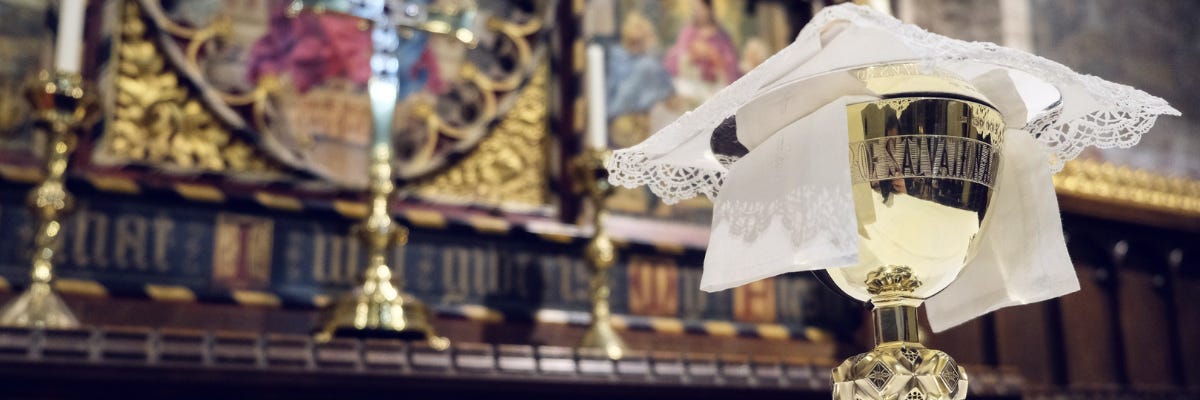
Holy Communion is one of the ways in which we abide in the vine. We eat the bread and drink the wine which represent the body and blood of Christ and become part of us: Christ abides in us. At the same time we ourselves rest Christ in this moment of drawing near in this precious sacrament of grace.
The heart of the service is where we come forward to receive. The priest invites us to draw near in these words:
“Draw near with faith.
Receive the body of our Lord Jesus Christ which he gave for you and his blood which he shed for you.
Eat and drink in remembrance that he died for you and feed on him in your hearts by faith with thanksgiving.
Every line is full of meaning.
We are invited to draw near: to come close to God, to the place where God has promised to meet with us. Because we are physical beings, flesh and blood, it can be helpful to get out of our seats and move – not because God is more present at one end of the church than the other, but because our moving signifies a desire to respond to God’s grace and presence.
We are invited to draw near with faith: believing the words of Jesus that Christ is here and will be near to us. We come with empty hands needing the gifts of forgiveness and new purpose and life which are in these simple actions.
We are invited then to eat and to drink the bread and the wine in remembrance that he died for you: to hold in our minds as we receive Holy Communion, Christ’s gift of himself on the cross and all this means for our salvation. Finally we are invited to feed on him in our hearts by faith with thanksgiving. Although the physical portions of bread and wine are small, we are invited to abide here, to savour this sacrament. This is the place to focus our hearts and our devotion as we return and kneel to pray: a simple act of thanksgiving.
As we eat and drink these holy gifts Christ is present. As we receive his body, together we become his body. We are transformed together into his likeness, each refracting a different part of the rainbow grace of God. Celebrating and receiving Holy Communion must always be more than an individual action. As we are united with Christ so we are united with one another around the table of the Lord. Our wounds are healed and our fellowship mended. We are becoming a church which is one, holy, catholic and apostolic.
As we rest in Christ the true vine and Christ lives in us, so our lives are caught up into the worship of heaven. That will be our theme next time: come and see…